About the Academy
Our Namesake: Frederick Douglass
The name is the argument. Our crest answers it in Latin — Sine Labor Nihil, without work, nothing.
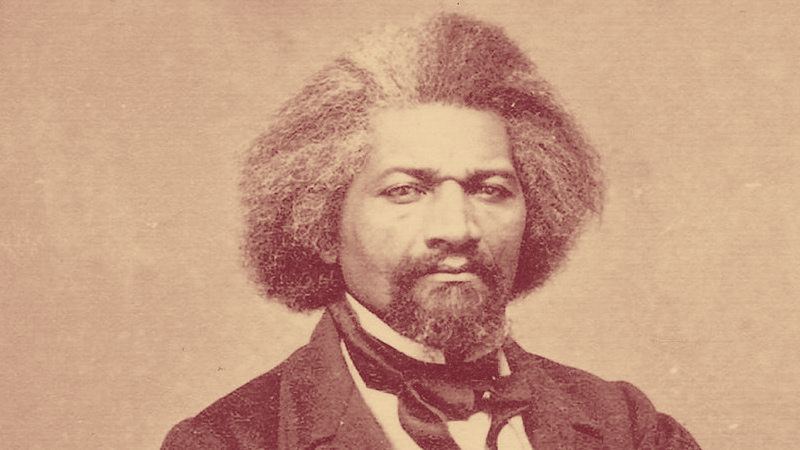
Frederick Douglass (1817-1895). An escaped slave, Frederick Douglass became one of the foremost black abolitionists and civil rights leaders in the United States. His powerful speeches, newspaper articles, and books awakened whites to the evils of slavery and inspired blacks in their struggle for freedom and equality.
Frederick Douglass was born Frederick Augustus Washington Bailey in Talbot County, Md., sometime in February 1817. His father was an unknown white man; his mother, Harriet Bailey, was a slave. He was separated from her and raised by her elderly parents. At 7, Frederick was sent to his master, Captain Aaron Anthony, at a nearby plantation. There he first met a brother and two sisters. He later recalled sadly that “slavery had made us strangers.”
When he was 8, Frederick became a servant to Hugh Auld, a relative of Captain Anthony who lived in Baltimore, Md. Frederick persuaded Auld's wife to teach him to read. But Auld believed slaves should not be educated and stopped the lessons. White playmates helped Frederick, and he soon learned to read well. A book of speeches denouncing slavery and oppression deepened his hatred of slavery.
In 1833 Frederick was sent to work for Auld's brother, Thomas, at a plantation near St. Michael's, Md. Frederick's pride angered his new master, who placed him in the hands of a “slave breaker” in an effort to “tame” him. One day the two fought, and Frederick emerged victorious. Sometime later he wrote that the fight had been a turning point in his life. “I was nothing before–I was a man now.”
In 1835 Frederick was put to work at a farm near Thomas Auld's plantation. In the following year he and other slaves plotted to escape to the North. Their plan was discovered, and they were jailed. Frederick was released and sent back to Baltimore, where he became a ship's caulker. Once, he was attacked by white workers who resented the competition of slave laborers. They went unpunished because the testimony of black witnesses would not be admitted as evidence in a court. For a while in 1838, Hugh Auld allowed Frederick to find his own jobs and to keep part of his wages.
On Sept. 3, 1838, Frederick escaped from slavery. With identification borrowed from a free black seaman, he traveled to New York City. In less than a day he was a free man. Soon after, he sent for Anna Murray, a free black woman from Baltimore. They were married and settled in New Bedford, Mass. There he took the name Frederick Douglass.
A Life
I was nothing before — I was a man now.
- 1817
Born Frederick Augustus Washington Bailey in Talbot County, Maryland.
- 1825
Sent to Baltimore as a servant; persuades Hugh Auld's wife to teach him to read.
- 1833
Sent to a plantation near St. Michael's and placed with a slave breaker — and fights back.
- 1838
Escapes to New York City. Marries Anna Murray and takes the name Frederick Douglass.
- 1895
Dies, having become one of the foremost abolitionists and civil rights leaders in the nation.